What Is a 6 Card Tarot Spread?
A 6 card tarot spread is a versatile layout that uses six cards to provide substantial insight into a question or situation. It's the perfect middle ground between quick three-card readings and intensive ten-card layouts like the Celtic Cross, offering enough depth to understand nuanced situations while remaining approachable for regular use.
Six-card spreads have become increasingly popular among both new and experienced readers because they're substantial enough to reveal hidden patterns and multiple perspectives, yet compact enough to read in fifteen to twenty minutes.
What does a 6 card tarot spread look like?
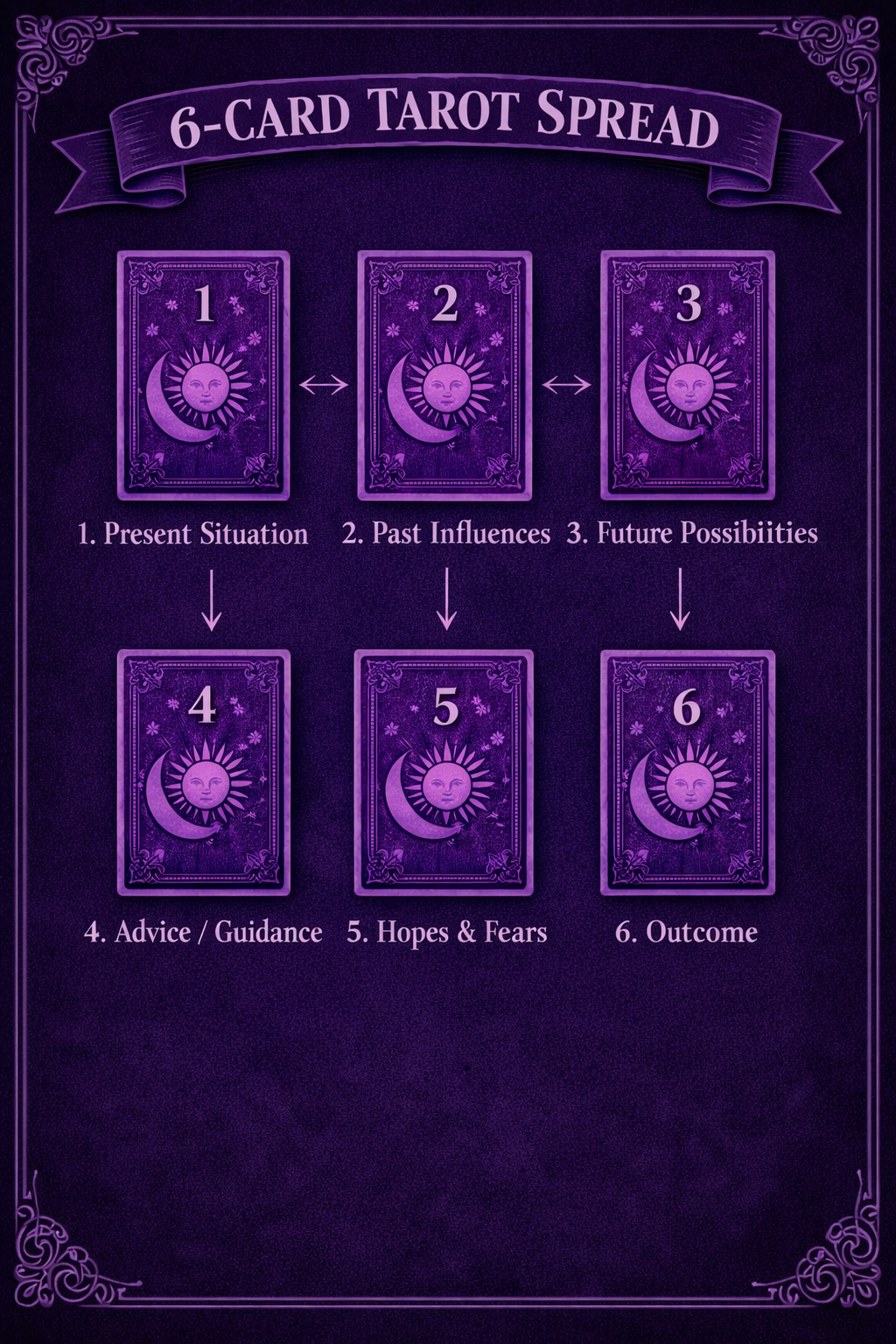
A 6 card tarot spread can be arranged in several configurations, most commonly as two rows of three cards, a single horizontal line, a pyramid shape, or a cross with additional cards. The layout you choose matters because it creates visual flow and helps you organize the question's different aspects.
Standard six-card layouts include:
Two rows of three cards
The most popular format arranges six cards in two horizontal rows, with three cards on top and three below. This creates a neat rectangular shape that's easy to read from left to right, top to bottom. Many readers use the top row for one aspect of the situation (like challenges or influences) and the bottom row for another (like actions or outcomes).
A single horizontal line
All six cards are laid out in one row from left to right, creating a timeline or progression. This works beautifully for questions about development over time or for understanding how a situation will unfold in stages.
A pyramid or triangle
Three cards on the bottom, two in the middle, and one at the top (or inverted). This arrangement naturally draws the eye upward to a culminating card, making it perfect for questions about goals, aspirations, or where a situation is building toward.
A cross with two additional cards
Four cards are arranged in a simple cross pattern (up, down, left, right) with two cards placed beside them for additional context. This creates a compact reading that borrows some structure from the Celtic Cross without its full complexity.
The beauty of six-card spreads is that once you understand the principles, you can create custom arrangements for specific questions. The key is that each position should have a clear, distinct meaning that contributes to answering your overall query.
What Are the Most Popular 6 Card Tarot Spread Formats?
The most popular 6 card tarot spread formats are the Two-Path Spread (comparing options), the Relationship Spread (exploring dynamics between two people), the Problem-Solution Spread (understanding issues and finding answers), the Timeline Spread (showing development over time), and the Self-Reflection Spread (for personal growth work).
The Two-Path Spread. Use this when choosing between two options. Layout: Three cards in a column on the left for Option A (outcome, challenge, hidden factor) and three cards in a column on the right for Option B (same positions). This side-by-side comparison illuminates both paths clearly.
The Relationship Spread. Perfect for understanding dynamics between two people. Layout: Top row shows Person A's feelings, needs, and what they bring to the relationship. Bottom row shows Person B's feelings, needs, and what they bring. This creates a balanced, compassionate view of both perspectives.
The Problem-Solution Spread. Ideal for practical guidance. Layout: Top row (cards 1-3) explores the situation; what's happening, why it's happening, and what's hidden. Bottom row (cards 4-6) provides guidance on what to release, what to embrace, and the likely outcome.
The Timeline Spread. Use for understanding how situations will develop. Layout: Six cards in a single row, reading left to right. Each card represents a time period (week, month, or phase) showing how events and energies will unfold over time.
The Self-Reflection Spread. Perfect for personal growth work. Layout: Cards 1-2 (past influences), Cards 3-4 (present situation and inner state), Cards 5-6 (guidance and potential future). This creates a journey from where you've been through where you are to where you're heading.
How Do You Read a 6 Card Tarot Spread?
To read a 6 card tarot spread, start by interpreting each card within its specific position, then look for patterns between cards (like multiple suits or court cards), notice the narrative or story the cards tell together, and consider how cards answer or respond to each other to reveal the full message.
Start with the obvious. Before diving deep, notice any immediate patterns. Are multiple cards from the same suit? Several Cups cards might indicate emotional themes dominating the reading, while multiple Swords cards suggest mental challenges or communication issues. Court cards like King of Cups or Page of Cups often represent actual people or personality aspects.
Read position by position. Interpret each card within its specific position's context. Eight of Swords means something different in a "challenge" position (feeling trapped by circumstances) versus an "advice" position (need to recognize self-imposed limitations).
Look for narratives between cards. Six cards tell stories when read together. If Three of Cups appears early showing celebration and friendship, followed by Four of Cups showing apathy or withdrawal, you're seeing a story about how initial joy may lead to taking blessings for granted.
Notice card relationships. Do certain cards seem to answer or respond to each other? If Nine of Swords appears in one position showing anxiety, and Six of Cups appears in another, the reading might be suggesting that revisiting innocent joy or past comforts could help ease current worries.
Consider elemental balance. Are all the cards from one element (all Cups, all Swords)? This suggests that particular energy, emotional, mental, material, or spiritual, is dominating the situation and may need balancing.
Example: In a relationship spread, you might pull Two of Cups in one person's position showing genuine emotional connection, and Seven of Cups in the other's position revealing confusion about what they truly want. The Queen of Cups appearing in "what they bring" might indicate emotional maturity, while Knight of Swords could show direct but potentially hasty communication. This combination suggests a strong bond clouded by unclear expectations that need honest discussion.
When Is a 6 Card Tarot Spread the Right Choice (and When It Isn't)?
A 6 card tarot spread is the right choice when you need relationship clarity, when comparing two or three options, for weekly planning, or when you need both problem analysis and solutions. It's NOT right for simple yes/no questions, when you're brand new to tarot, for extremely complex situations, or for quick daily guidance.
Use a six-card spread for:
Relationship dynamics. Exploring how each person feels, what each needs, and where the partnership is heading
Decision-making between options. Comparing two or three paths with dedicated cards showing outcomes and challenges for each
Understanding complex emotions. Situations involving conflicting feelings that need nuance (Five of Cups grief alongside Ace of Cups new beginnings)
Weekly or monthly planning. Mapping time periods with themes for each phase ahead
Problem-solving. Dedicating half the cards to understanding issues and half to actionable solutions
Don't use a six-card spread for:
Simple yes/no questions. "Should I call him tonight?" needs one card, not six
When you're brand new to tarot. Start with one-card or three-card spreads until you're comfortable with card meanings
Extremely complex situations. Multiple life areas with many factors need the Celtic Cross's ten positions
Quick daily guidance. Morning routines don't need six cards of analysis
When you need exhaustive detail. Major life transitions benefit from more comprehensive spreads
The six-card spread represents tarot reading at its most practical and accessible: substantial enough for real insight, manageable enough for regular use.
Whether you're examining love, making decisions, or seeking personal guidance, these versatile layouts provide the perfect framework for meaningful readings without overwhelming complexity.