Star Tarot Spread: How It Works and How to Read It
The star spread arranges six cards in the shape of a five-pointed star: one card at each of the five points, and one card in the center. Unlike linear spreads that move through time from left to right, the star's radial structure treats each outer position as equally weighted, no single point dominates the others. Everything radiates from and returns to the center, which holds the reading's core theme.
This makes the star spread particularly well-suited to questions that don't fit neatly into a timeline. When you want to understand a situation from multiple angles simultaneously, rather than track it from past to future, the star gives you that kind of panoramic view.

Not to be confused with The Star tarot card.
The Six Positions of the Star Tarot Spread
Center — The Core Theme
The card in the center anchors the entire reading. It represents the central energy, theme, or question at the heart of the situation. All five outer cards are read in relation to it. The High Priestess at the center points to a reading defined by intuition, hidden knowledge, and the need to look inward. The Fool suggests a situation defined by new beginnings and the open-ended uncertainty that comes before a path is chosen.
Point 1 (Top) — The Present Situation
The topmost card describes where the querent currently stands, the circumstances, energy, and conditions that define the situation right now. It's the most grounded of the five outer points, dealing with what's already visible and known.
Point 2 (Upper Right) — What's Helping
The upper-right point identifies the supportive forces available to the querent: strengths, resources, people, or energies that work in their favor. This card is worth sitting with — readers often overlook what's going well in favor of focusing on challenges.
Point 3 (Lower Right) — What's Hindering
The lower-right card identifies what's working against the querent: obstacles, blind spots, patterns, or external pressures that complicate the situation. Read this card in direct conversation with the card at point 2. The contrast between what's helping and what's hindering is often where the most useful tension in the reading lives.
Point 4 (Lower Left) — What to Learn or Accept
This position asks a slightly different kind of question. It's not about what's happening in the external situation, but about what the querent needs to understand, integrate, or accept to move forward. The Hanged Man here is a powerful draw, it typically calls for a shift in perspective rather than a change in action.
Point 5 (Upper Left) — The Likely Outcome
The upper-left point shows where the situation is headed if current energies continue. As with any outcome position in tarot, this is a reflection of trajectory rather than a fixed result. It's what's most likely, not what's inevitable.
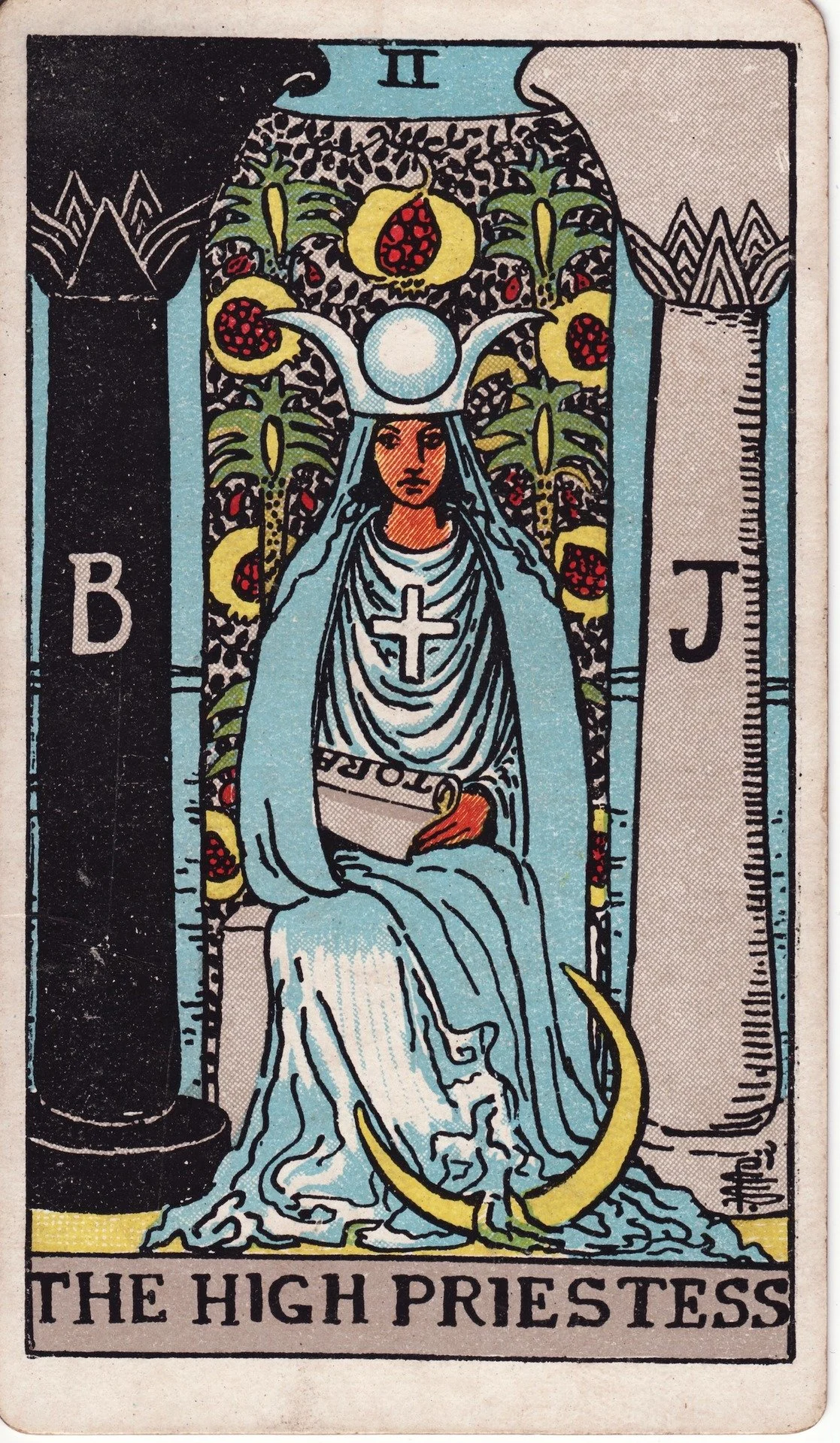


The High Priestess, The Fool and The Hanged Man tarot cards.
How to Do a Star Reading
Set your question or intention before shuffling. The star spread handles both specific questions and broader situational inquiries well — the center card will establish the frame for whichever approach you take.
Shuffle with your question in mind and draw six cards. Place the center card first, then the five outer cards moving clockwise from the top point. Turn them over starting with the center, then work clockwise through the five outer points.
Interpret each card in its position as you go, then step back and read all six together as a complete picture.
Reading the Star as a Whole
The star rewards readers who look at pairs and oppositions rather than reading each point in isolation. The most productive pairs to examine are the two that flank each other on the same horizontal or diagonal axis.
The helping/hindering pair (points 2 and 3) is the most direct comparison in the spread — it maps what's supporting the querent against what's working against them. When these two cards are from very different suits or carry sharply contrasting energies, the reading is describing a situation with genuine tension. When they're similar in tone, the situation has a clearer momentum in one direction.
The learn/accept card (point 4) and the center card are worth reading in tandem. The center describes what the situation is essentially about; point 4 describes the internal work required to navigate it. Together, they often reveal the gap between where the querent is and where they need to be.
If you use elemental associations, the five points of the star can also be read as the five elements — earth, water, fire, air, and spirit — assigned to each point in a fixed order. This layer of interpretation enriches the reading for readers who work with elemental dignities, though the positional meanings above work just as well without it.
When to Use the
The star spread is the right layout when a situation has multiple dimensions that don't reduce neatly to a timeline. It works particularly well for self-reflection, for situations where you need to take stock of all the forces at play before deciding on a course of action, and for questions where internal factors (what to learn, what to accept) are as important as external ones.
Its symmetrical structure also makes it one of the more visually intuitive spreads to lay out and read. The shape itself communicates balance, and readers who are visually oriented often find it easier to hold in mind than a linear layout of the same number of cards.
If your question is primarily about timing or you need to trace a clear progression from cause to outcome, a horseshoe tarot spread or the Celtic Cross tarot spread will serve you better. The star's strength is breadth and balance, not sequential depth.
Explore more spread layouts: Tarot Spreads by Layout
Deepen your card knowledge:
Major Arcana · Cups · Swords · Wands · Pentacles